
AI in the Construction Industry: 2024 Forecast
Tristan Ratz · Friday, October 27, 2023 · 6min
Since the breakthrough of ChatGPT, artificial intelligence (AI) has been on everyone’s lips. But how does this technology affect the construction industry? Are changes on the horizon, or even a revolution? In 2024, the answers might surprise you. Dive in with us to discover the most exciting developments and forecasts.
What exactly is artificial intelligence (AI)?
Artificial intelligence (AI) refers to computer systems that handle tasks that normally require human thinking. This is not about machines that “think” like humans, but about programs that can analyze data, recognize patterns and make decisions based on them. In practice, AI can be used, for example, to optimize workflows, detect errors early on or support planning processes. For the construction industry, this means: more efficient projects, fewer unexpected problems and an overall smoother construction process. But how exactly does AI influence the workflows and techniques in the construction industry?
What does AI mean for the construction industry?
AI is revolutionizing numerous industries, and the construction industry is also facing profound changes. While many people associate AI with futuristic technologies and automation, at its core it is about optimization and efficiency gains. For the construction world, this can mean: more precise planning, early error detection and improved resource management. It is not just about replacing human activities, but rather about improving and expanding them, so that construction professionals can focus on more complex and creative aspects of their work.
Which practical use cases does AI offer the construction industry?
The impact on the construction industry naturally cannot be summed up in a single sentence and varies depending on the sector and the activity performed. However, it can be noted that so far only 6% of companies in the construction and real estate industry use AI[4]. But let’s take a more nuanced look at the potential possibilities:
- Design optimization: AI can help optimize building designs to increase efficiency in terms of energy consumption and material usage.
- Generative design: By using generative design, algorithms can create a wide range of design options that meet the requirements while minimizing costs and resources.
- Surveying technology: Drones and automated surveying systems can measure the construction site area optimally, allowing this work to be done more effectively.
- Document recognition: AI can easily read out documents, digitize and analyze them.
- Time and resource management: AI can help optimize the schedule and resource allocation for construction projects by analyzing historical data and real-time information.
- Risk management: Predictive models can be used to forecast and minimize risks associated with construction projects.
- Autonomous construction machinery: Self-driving construction machines, such as excavators and bulldozers, can be equipped with AI systems to perform more precise and efficient tasks on the construction site.
- Construction site safety: AI-powered camera systems can be used to monitor construction site safety in order to prevent accidents and injuries.
- Image recognition: AI can use images and videos to perform quality control on the construction site and detect defects or problems early on.
- Automated entry control: Recognition of license plates to admit authorized and announced vehicles.
- Automated surveillance: Detection of anomalies, for example in night-time monitoring
- Predictive analytics: AI can help forecast material requirements and inventory levels to avoid bottlenecks in the supply chain.
- Route and area optimization: Algorithms can calculate the most efficient delivery routes for construction sites and material transports.
As we can see, the possibilities of AI in the construction and real estate industry are very impressive. But as with any innovation, there are also aspects that need to be carefully considered. So what difficulties can arise when using AI in this industry?
Guide - How do I integrate AI into my existing construction processes?
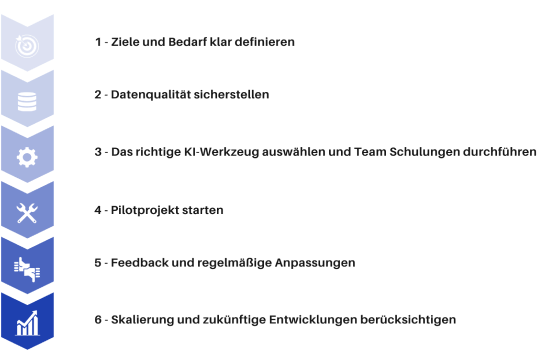
1. Clearly define goals and needs
Determine clearly which specific problems or challenges you want to solve with AI. Do you want to increase efficiency, reduce costs or improve safety on construction sites?
2. Ensure data quality
Review the quality and quantity of the data available to you. Good data is the key to a successful AI system.
3. Select the right AI tool and conduct team training
Choose suitable AI tools and invest in training your team so that it can work effectively with the new technologies.
4. Start a pilot project
Start with a smaller, controlled project to test the effectiveness of the AI solution before implementing it across the entire company.
5. Feedback and regular adjustments
Establish a process that collects feedback and, based on it, carries out regular reviews and optimizations.
6. Consider scaling and future developments
After successful implementation, expand the use of AI to other areas and always stay up to date on new AI trends.
Which challenges arise when using AI in the construction industry?
AI can be used in increasingly broad ways, as we have seen, and appears to be transforming many sectors. So why don’t we see AI everywhere yet? That is because AI is far from being able to do everything and has many problems that are far from being solved. Here are just a few of the issues that arise when using AI:
Specialization - Often an AI only works for a very specific task. For example, recognizing different vehicle types or license plates. In these specialized tasks, it can even surpass human accuracy. However, this is also the catch: if the same AI is to be used for a different task, such as recognizing employees, it is usually not possible and requires retraining the AI, which is very time-consuming.
Complexity - AI models can be developed in such a complex way that even experts do not always understand how the AI’s decisions come about. Researchers are trying to make these models clearer and more reliable.
Genuine intelligence - Despite all the headlines and movies, AI is not as smart as is often claimed. It is more of a powerful tool than an all-knowing machine. To ensure that this tool is also applied correctly in the construction industry, many companies are currently investing heavily in upskilling their employees [5].
Data quality - The quality and effectiveness of artificial intelligence (AI) in the construction sector depends largely on the data it is trained and operated with. In 2023, collecting correct and comprehensive data is at the forefront of the challenges. It is essential for construction companies to determine exactly which data is required for their AI applications and to ensure that they have access to all relevant data sources.
Without the capture of digital data in construction projects, AI cannot work effectively. Therefore, digitizing processes on construction sites is a logical step toward exploiting the full automation potential of AI, as a recent McKinsey study[6] also underscores.
Is my job at risk?
In times of technological progress, the question is often raised whether human labor will be replaced by machines. With artificial intelligence, this debate is particularly intense. But instead of fearing AI, we should take a closer look at its possible applications and effects on various occupational fields in the construction industry.
Construction workers: While AI and autonomous equipment can take over some manual tasks, the need for human expertise remains high. Complex tasks and equipment maintenance in particular still require the knowledge and skills of skilled construction workers.
General contractors and subcontractors: These groups can benefit from digitization in the form of improved project control and communication. However, it will be important to adapt to new technologies and train employees in their use.
Service providers: For companies offering specialized services such as construction site security or quality control, artificial intelligence (AI) offers the opportunity to optimize their offerings through automation. This can lead to more efficient and cost-effective solutions.
So it can be said: AI will change the construction industry, but not necessarily displace jobs. Instead, new, innovative fields of activity can emerge that combine human skills with technological progress.
Where is AI already being used today?
And you can probably guess it already: AI is also used in construction site software. For example, in document management, documents can be read out using specialized models and the data can be adopted without further adjustment. That way, everyone can save a bit of time and typing effort.
The use of AI also makes a lot of sense in construction logistics: how about license plates of incoming vehicles simply being recognized and the barrier opening for announced deliveries without any manual check?

Take Your Knowledge to the Next Level!
Deepen Your Knowledge
Discover informative insights into the construction industry through our blog posts while we take care of your request.
Expert Knowledge
Copying Access Cards? Why MIFARE Classic Is a Security Risk on Construction Sites

Christopher Sura

Expert Knowledge
Data Protection - Access Control on the Construction Site
Christopher Sura
Expert Knowledge
AI in the Construction Industry: 2024 Forecast

Tristan Ratz
See Bausicht in Action?
Schedule a no-obligation demo appointment to learn how Bausicht can save you time and money in the future.