
Construction Site Documents: From Paper to Digitization
David Licow · Monday, August 21, 2023 · 5min
The construction industry is at a turning point. In light of rising construction costs and higher interest rates, it is becoming clear that conventional methods of document management need to be rethought.
It is no longer just about the convenience of the digital age, but about a more efficient and cost-saving way of working. The shift from paper to digital is therefore not a short-lived fad, but a sustainable response to changing market conditions.
In this post, we trace the path from traditional construction site documents to digitization and explain why this step is more important today than ever.
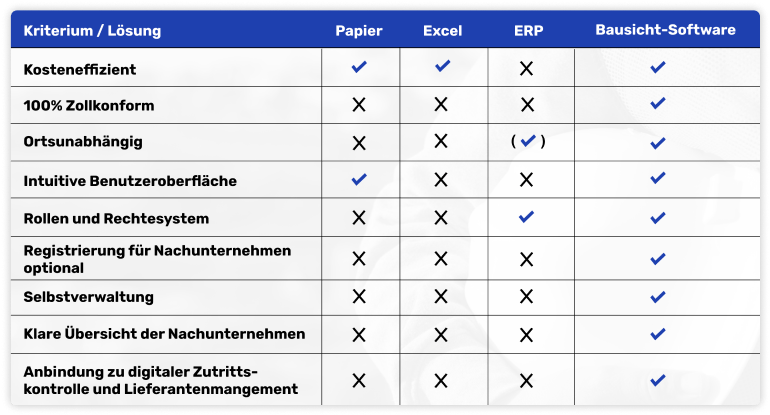
A Quick Overview of the Methods
“Bausicht’s traffic light system makes my work clearer and easier. It never lets me down when it comes to making sure all our certificates are complete and up to date. No complicated training required!”
-Nadine Widmann, Turnkey Construction Assistant at Krämer Bau
Book a free demo to learn more about building in compliance with customs and authority requirements and release from liability toward trade associations and social insurance funds:
The Traditional Method: Paper
The advantages of paper-based management include its physical tangibility and independence from electronic systems – a tradesperson can access a handwritten plan even without internet access or electricity. In addition, it offers a visual experience that makes things easier to understand for some people.
But these advantages are accompanied by numerous disadvantages.
Pitfalls and Disadvantages of the Paper-Based System
The paper-based system is prone to human error, physical damage and loss. Finding information can be time-consuming, and storing paper documents takes up a lot of space. In addition, updates and changes are more difficult to carry out and can easily lead to errors, especially when multiple parties are involved. Inadequate documentation can lead to the following consequences:
Employment law consequences Under legislation to combat undeclared work, companies can be excluded from public tenders for up to three years if they engage in undeclared work or employ foreign nationals without a valid work permit.
Fines and back payments In the case of incorrect or incomplete documents, the company can be subject to fines
Reputational damage A violation of the regulations can damage the company’s image.
The Half Step Forward: Excel
Advantages of Excel-based management: With Excel, you have everything in one place. Due dates, names of subcontractors and which documents have already been received. If a document is about to expire, you can mark it manually in Excel and thus keep track of things.
Disadvantages of Excel
The Excel program is not made specifically for construction. It lacks automatic reminders when documents are about to expire. With a high number of subcontractors, it quickly becomes confusing and the administrative effort increases enormously.
Another major problem lies in the lack of self-management by subcontractors: general contractors constantly have to chase them down to obtain the necessary documents. This not only ties up many resources and skilled workers who could be deployed more productively elsewhere, but also increases the risk of manual errors. These errors can, especially in the construction industry, lead to significant problems and costs. Excel is therefore only an intermediate step – it is certainly better than paper, but far from the ideal solution.
ERP Systems: Not Always the Golden Mean
Advantages for the construction industry: ERP systems bundle many business processes on one platform, from project planning to personnel management. This particularly simplifies the document management of subcontractors, making it seem like everything is under control: existing and missing certificates, upcoming renewals and more.
Limits of ERP
Despite their advantages, ERP systems have clear weaknesses. They are often complex and require extensive training. They are also inflexible. Important functions are often missing, especially in document management: many workflows are manual, and there is a lack of automatic notifications, self-management by subcontractors and clear reporting tools. As a result, some systems can quickly reach their limits given the sheer volume of documents and the large number of subcontractors. Specialized software tailored to these challenges can offer clear advantages here and relieve general contractors.
Why Specialized Software Is the Gold Standard:
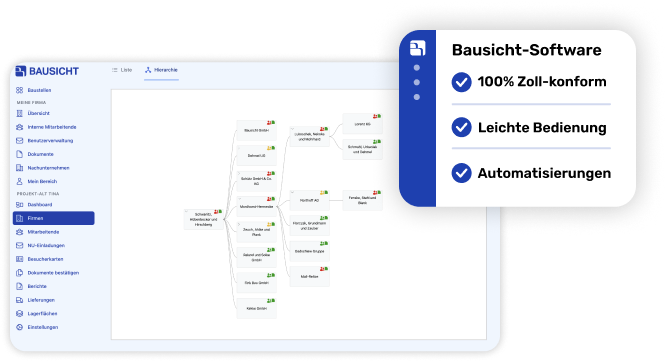
Our specialized software solution puts precisely these requirements at its core. It was developed to provide construction companies with an effective, simple and reliable platform. Through automation and clear structures, it reduces manual effort and drastically lowers sources of error. In addition, subcontractors can be actively involved in the process, which in turn saves your own skilled workers’ time.
“We spend less time chasing subcontractors over daily changing personnel and can therefore focus more on the actual challenges of a construction site.”
-Thomas Feigl, Head of Work Preparation at Mauss Bau

Take Your Knowledge to the Next Level!
Deepen Your Knowledge
Discover informative insights into the construction industry through our blog posts while we take care of your request.

Expert Knowledge
Copying Access Cards? Why MIFARE Classic Is a Security Risk on Construction Sites

Christopher Sura

Expert Knowledge
Data Protection - Access Control on the Construction Site
Christopher Sura

Expert Knowledge
AI in the Construction Industry: 2024 Forecast

Tristan Ratz
See Bausicht in Action?
Schedule a no-obligation demo appointment to learn how Bausicht can save you time and money in the future.